
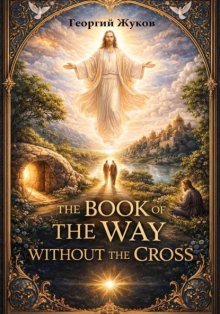
The way without the cross бесплатное чтение
“Professor Stravinsky saved me from interrogation.
He declared me insane.
For only a madman, in our time,
could write a novel about Christ and Pilate.”
– The Master and Margarita (film),
dir. Yuri Kara, 1994
On the Shadow Cast by Another Eternity
In the beginning was the Word. The Word was with God, and the Word was God. All things came into being through Him; without Him nothing would exist. This truth is as immutable as the alternation of day and night.
When the Word became flesh and dwelt among us, a new possibility entered the world. Not another truth – but another mode of its manifestation.
One may imagine human history not as a straight road toward a single destination, but as an immense tree with countless branches. Upon each branch unfolds a world shaped by different choices. Somewhere Adam withstood temptation. Somewhere Cain did not raise his hand against Abel. Somewhere Pontius Pilate perceived in the Unusual Prisoner not a threat, but a pillar of order.
This book is not about what never happened. It is about a world that, like a shadow, reflects our own. Imagine: redemption came otherwise. Not through blood upon a cross, but through quiet tears in the Garden of Gethsemane. Not through a sudden blaze of light at the hour of death, but through a patient light burning for decades.
It is a story about humanity deprived of its most convenient justification – the sacrifice of Another. About a world in which salvation ceased to be a single event and became instead a long process. About a human being who can no longer shift responsibility for his choices, fears, love, and life onto someone else.
This book does not answer which path is better. Love is not compared – it simply is. In our history, love chose the Cross. In this one, it chooses something else: it is crucified not upon wood, but within human hearts – in the hearts of those who forgot the Teacher’s words, who, having witnessed miracles, demanded more, who swore fidelity yet retreated before fear.
This path is no easier – perhaps it is even harder. To die for another is a great act of love. But a greater trial still is to live for him, watching as he repeatedly chooses darkness. That is love without end.
On this path there is no Golgotha, yet there are countless small trials. No Resurrection once and for all, yet a daily victory of spirit over weakness. No Cup drained to the dregs, yet a river from which one must draw every morning in order to carry light into a world thirsty for goodness.
This is the Way Without the Cross. Not because sacrifice is absent, but because sacrifice has become life itself.
This book is not about faith as a system. It is about faith as a manner of living.
Author’s preface
On the Path We Did Not Walk – Yet Which Brought Us to Ourselves
This book was born in silence – in the space where the Gospels fall quiet, leaving room for unspoken words. In that pause between the strike of the hammer and the groan of the crucified, another reality might have come into being.
What if everything had unfolded otherwise? What if Pontius Pilate, instead of washing his hands, had listened to that very word – “truth” – about which he questioned his prisoner?
This is neither a retelling of Scripture nor a speculative game of “what if.” It is a meditation on divine omnipotence: if God is truly almighty, might there not have been more than a single solution?
We have grown accustomed to believing that salvation could come only through the Cross. So prophecy speaks; so the Church teaches. Yet God respects human freedom – and perhaps, on that day, freedom might have manifested not only in Christ, but also in a human being – in the person of Pilate.
Could redemption come not through death, but through life? Not through an instantaneous sacrifice, but through long years of transformation?
From these questions arose The Book of the Way Without the Cross. It does not seek to alter Holy Scripture, but to ask sincerely: wherein lay Christ’s supreme sacrifice? Only in the suffering of the Cross? Or also in the willingness of His love to walk any road – if only humanity would turn toward the light?
This is a book about love without boundary. About love prepared to accept any outcome so that a spark of goodness might ignite within the human heart.
Important note
The Way Without the Cross is a philosophical–theological parable in literary form.
All characters, events, and images constitute artistic imagination and do not claim to reinterpret, revise, or negate religious dogma, canonical tradition, or doctrinal teaching.
The text is not a theological treatise, a religious doctrine, or an alternative confession of faith. It is intended as a philosophical and artistic reflection on faith, freedom, and human responsibility.
I. Theology of possibility
Why This Path Could Have Been
We are accustomed to thinking that only the Cross could atone for human sin. Prophecy spoke of it; the Church proclaims it. Yet let us consider: God is freedom itself. He is bound by no necessity and acts according to His sovereign will.
Long ago, theologians asked whether God might have saved humanity otherwise. Thomas Aquinas answered that the Cross was the most fitting way – but not the only possible one. For God is love. And love seeks not merely to exact payment, but to heal – to restore the human heart.
If redemption had required not death upon a cross but a long and difficult life – filled with rejection, misunderstanding, loneliness – could God not have walked that path? Surely He could. And perhaps that, too, might have been His choice.
We often regard Golgotha as the singular moment of sacrifice. Yet was not the entirety of Jesus’ life – from birth in a stable to His final days – itself an immense act of humility and love? Every mockery, every betrayal, even the incomprehension of His closest disciples – all this belonged to sacrifice.
This book invites another perspective: perhaps Christ’s sacrifice was not one terrible hour, but thirty-three years of self-giving. A sacrifice unfolding day by day, composed of small, unseen acts of patience and love.
Perhaps the essence lies not in the manner of the sacrifice, but in the fact that God’s love proved stronger than pain and suffering. That He was willing to walk any road, so that humanity might once more become capable of goodness, capable of returning to the light.
II. Historical context
Roman Pragmatism versus Religious Zeal
To understand Pilate’s decision, we must enter his world. Pontius Pilate was no fairy-tale villain. According to Philo of Alexandria and Josephus, he was a severe and pragmatic administrator. Above all he valued order and stability within the province. Judea seemed to him a burdensome posting – a restless land at the edge of the vast Roman Empire, almost a place of exile.
On the eve of the trial, Pilate receives numerous reports. He learns that executing a preacher beloved by many could ignite rebellion in Jerusalem – crowded with pilgrims for Passover. He also hears that this Yeshua teaches, “Render unto Caesar what is Caesar’s” – a call to civic obedience.
Pilate, an experienced Roman official, begins to calculate: what better serves Rome? To kill the preacher and create a martyr whose death might inflame the province? Or to let him live – and allow him to teach humility and submission?
If Pilate releases Yeshua, it is not conscience that speaks, but cold calculation. He thinks in terms of imperial interest, not justice. Yet herein lies the paradox: that very calculation, devoid of lofty sentiment, might have opened the path capable of altering history.
A path humanity could have taken – but did not. And yet it was possible.
III. Philosophy of the way
The Meaning-Forming Power of Choice and Responsibility
Where does true freedom lie? In suffering – or in love? In passive acceptance of destiny – or in the courage to shape it?
Christian tradition often sees the path to God as the bearing of one’s cross – through illness, loss, deprivation. This is a profound and authentic path. Yet here we consider another dimension.
Here the “cross” signifies not suffering alone, but conscious choice: the labor of transforming the world for the better. Not heroic death, but the patient, daily work of healing, teaching, and restoring wounded souls.
Yeshua does not die upon the cross in this narrative. Yet another death awaits him – the death of being forgotten, misunderstood, rejected by those unable to accept him alive. He walks a path akin to that of the Old Testament prophets: wandering, persecuted, alone. His sacrifice is not a moment, but a lifetime. Each day he gives himself anew.
What transforms the world more deeply: a single supreme act of love at death’s hour – or the same love that labors patiently for years without glory or recognition?
Perhaps the true strength of love lies not in a brilliant flash, but in a steady light that dispels darkness day after day. In loving not for a moment, but for a lifetime – even when misunderstood, even when forgotten.
IV. Literary tradition
In Search of a Lost Possibility
This book invites us to hear Christ’s teaching not as memory of the Crucified, but as the living word of the Teacher. Such a perspective clears away centuries of polemic and allows the teaching to be seen anew.
At times I depart from historical detail (for example, in references to events in Edessa), but within the freedom of literary narrative, this may be forgiven.
Imagine the Sermon on the Mount spoken not on the eve of death, but at the beginning of a long road. Less foreboding of an ending – more faith in daily goodness. The parables shift likewise: from eschatological warnings to practical instruction in how to live each day – to forgive, to love, to do good.
The same words may inspire not only a momentary heroic act, but a lifetime of quiet service. Perhaps the heart of the teaching lies not in when or how it was spoken, but in the fact that it remains alive – in every heart, in every age. Its power is not in tragic finale, but in truth needed both in suffering and in ordinary days.
V. a spiritual testament
What This Book Is Truly About
The Book of the Way Without the Cross is not a speculative diversion. It is a parable about the fact that each of us participates in the work of salvation – here and now.
The Cross does not disappear; it changes. It becomes the cross of love, mercy, and patience borne by all who follow Christ. This cross is heavier than wood: it must be carried for a lifetime, without expectation of glory or gratitude.
This book is an invitation to reflection. On how we understand sacrifice, redemption, freedom, and love today. On seeing Christianity not only as memory of the past, but as a living path.
Perhaps after reading, you will look differently at the Gospel. Or you will ask yourself: what cross do you bear? And will you have the strength to bear it with dignity – as He bore the Way Without the Cross, so that we might learn to love.
With profound respect for your own search for Truth,
George A. Zhukov
The book of the way without the cross
Chapter 1
The Fourth Hour of the Night, or Roman Calculation
The dampness of Jerusalem before dawn hung thick as oil. It absorbed the smoke of extinguished fires, the dust of parched streets, and anxiety – sticky, invasive, inescapable. The anxiety of a city swollen with pilgrims, like a bale of hay crammed tight by a soldier who does not fear fire.
Pontius Pilate, the fifth Prefect of Judea, stood at the open window of the praetorium, feeling no coolness. He felt only the weight of his senatorial ring upon his finger – a symbol of authority that, in this accursed province, had become a burden.
From the direction of Gethsemane came fading echoes. Yeshua Ha-Nozri. The name turned in his mind like the report of a legate. Not prophet. Not healer. Not messiah. A problem. A problem that the High Priest Caiaphas, bowing yet with a snarl beneath his courtesy, had delivered to him – a Roman official – upon a platter, seasoned with accusations of violating imperial law.
“He calls himself king,” Caiaphas’ voice coiled in Pilate’s memory like a serpent. “King of the Jews. Against Caesar.”
Pilate clenched his fists. He knew the price of such words. To know whom to crucify and whom to spare – that was the higher mathematics of power at the edge of Empire. Crucify the wrong man and reap revolt. Spare the wrong man and a denunciation would swiftly reach Rome: the prefect grows soft. And a denunciation from Caiaphas – who possessed connections in the very court of Tiberius on Capri – was more dangerous than the dagger of a sicarius.
He turned from the window. In the glow of oil lamps, his face – weathered by desert winds – seemed carved from aged marble, hard and impenetrable.
“Bring him. Alone.”
The guards led the Man inside. He was not beaten as others often were. His hands were bound with a leather strap, nothing more. His clothing was simple, dusty. But his gaze—
Pilate had seen the eyes of slaves, kings, dying gladiators, madmen. He had never seen such a gaze. There was neither fear nor defiance. There was weariness – deep as the mouth of the Tiber – and within that depth, an unshakable peace. A peace that irritated Pilate more than any insult could have.
“Are you the King of the Jews?” the procurator asked, his voice dry, professional.
The one called Yeshua looked at him, and Pilate had the strange impression that this man did not see the walls of the praetorium, but something distant – perhaps even Rome itself.
“You say this because I have said it. My kingdom is not of this world. If my kingdom were of this world, my servants would strive that I should not be delivered to the Judeans.”
Pilate allowed one corner of his mouth to curve. Not of this world. The phrase of a philosopher. Or of a very subtle politician. There was no call to rebellion in it. No denial of Caesar’s authority. There was something more dangerous – a quiet negation of foundations. This Nazarene was playing another game, by other rules, and Pilate sensed instinctively that upon his own board he was but a pawn.
At that moment, without awaiting permission, Lucius the centurion, commander of the night watch, entered the chamber. He was pale – which, for a seasoned soldier, was akin to panic.
“Prefect,” he said tightly, “there is a crowd at the gate. Several hundred. The priests have stirred them. They demand the Nazarene’s blood. But… our scouts report zealots among them. Many.”
Pilate froze.
Zealots. Fanatics for whom any pretext sufficed to ignite rebellion. Passover. A city overflowing. The execution of a preacher beloved by the people—
It would not be an execution. It would be a spark in a powder keg.
“They shout: ‘Crucify him! We have no king but Caesar!’” Lucius reported, and bitter irony colored his voice.
Then the thought struck Pilate like lightning – clear, cold, honed like a legionary blade.
We have no king but Caesar.
Words he had never heard sincerely from the lips of Judean priests. It was flattery. Crude, desperate – and in its desperation, revealing.
They fear him more than I do. They fear that the Nazarene’s teaching will undermine their own authority. They are using Rome to rid themselves of a private enemy.
And Pontius Pilate, Prefect of Judea, made his decision.
Not as judge.
As politician.
As Roman.
He stepped onto the lithostrotos, the stone pavement before the praetorium. The crowd roared at the sight of him. Caiaphas, standing in front, wore a smile sharpened for triumph.
Pilate raised his hand. Silence fell.
“I find in this man no guilt deserving death.”
A gasp rose from a thousand throats – astonished, furious. Caiaphas’ head snapped upward, his face contorted.
“But according to custom, at Passover I release one prisoner to you!” Pilate continued, his voice ringing above the swelling murmur. “Choose! Barabbas, robber and murderer – or Yeshua, called Ha-Nozri?”
He knew the answer. He counted on it.
The crowd, driven by the priests like cattle, roared:
“Barabbas! Give us Barabbas!”
Pilate surveyed them slowly. His gaze fell upon Yeshua, who stood unmoving, looking somewhere beyond the heads of the crowd – toward the waking east.
Then Pilate spoke words that were destined to enter history – though not as an act of cowardice, but as an assertion of supreme state authority.
“So be it,” his voice cut through the morning air, clean and cold as steel. “You shall have what you ask. The brigand is yours. And this Man—”
He paused, allowing the weight of his words to settle.
“—I, Pontius Pilate, Prefect of Judea, declare religatus within this province. He shall be banished beyond its borders before sunset. Guards, return the Nazarene to custody. His fate will be decided by Roman law – not by your cries.”
He turned and left the platform, heeding neither the howl of the crowd nor the hissing curses of Caiaphas.
He had spared Rome unnecessary bloodshed – and spared himself a political headache.
He did not suspect that he had just altered the course of history – releasing into the world not an executed martyr, but a living prophet whose teaching, stripped of the aura of sacrificial death, would travel a different and far more arduous road.
And in the east, above the mountains of Moab, a new day was rising.
Chapter 2
The Prefect’s Report: Justification of the Decision
After it was not the prison door that closed behind the condemned, but the frontier post at the border of Samaria, Pontius Pilate withdrew to his study. The air within still carried the dust and tension of the previous night. Ordering ink, a scroll, and wax tablets for drafting, he entered silence, selecting words that were not meant to justify, but to explain to the Emperor the logic of his action.
This was not the report of a subordinate seeking pardon, but the memorandum of a strategist – cold, deliberate, layered with meaning.
[Preliminary Draft on Wax Tablets]
Copy. Ref. No. [Illegible]
From: Pontius Pilate, Prefect of Judea
To: Tiberius Caesar Augustus, Emperor of Rome
Date: Approximately the 18th day before the Kalends of May, in the year of the Consulship
Gaius Pontius Pilatus to Tiberius Caesar Augustus, Emperor – greetings.
In Your last communication, You wisely reminded me that governance of a province requires constant vigilance, and that our duty lies not in pleasing the crowd but in preserving the peace of the Empire and ensuring the uninterrupted flow of tribute to its treasury. Guided by this supreme principle, I have made a decision which I consider it my obligation to report to You directly.
The matter concerns one Yeshua, called Ha-Nozri (the Nazarene), whom the local high priests and elders accused of sedition, naming him “King of the Jews.” After personal examination conducted during the night, no substantive evidence supporting this charge was found. This man is a preacher, a philosopher from Nazareth, whose discourse concerning a “kingdom not of this world” resembles the speculation of a mystic more than a program of political revolt.
Yet his innocence is secondary. The issue lies in consequences.
At Passover, Jerusalem is overcrowded. The execution of a popular preacher would have provoked unrest. The implications are evident: disturbances would have paralyzed not only the city but the trade routes. Tax collection would have been disrupted. Losses would have exceeded any conceivable gain. Order remains the treasury’s priority.
Intelligence reports indicated the presence of zealots among the crowd. The death of the preacher would have furnished them with a banner for insurrection. The two cohorts stationed in the Antonia fortress are insufficient for large-scale suppression. Any crackdown would have resulted in destruction, resentment, and the creation of a martyr. Therefore, I resolved to deprive the agitators of a symbol.
The accusers – Caiaphas and his circle – sought removal of a rival undermining their authority. It is inadmissible to allow Roman force to serve intra-Judean rivalries. Rome dictates terms; it does not submit to them.
Barabbas was released – a visible concession to the crowd. Yeshua Ha-Nozri was expelled from the province – without execution, yet without acquittal.
Thus I have:
• eliminated the immediate pretext for revolt;
• demonstrated to the high priesthood that ultimate authority resides with Rome;
• removed a potential source of unrest without creating a martyr;
• safeguarded the economic interests of the Empire in the region.
I consider this decision the only prudent one. A living, exiled preacher presents no danger. A dead one would have become a symbol, and his grave a site of pilgrimage for the discontented.
Rome’s strength lies not in blind cruelty, but in sober calculation. I chose the course that strengthens our authority without unnecessary risk. Roman dominion must not tremble because of a wandering preacher.
May the gods preserve You.
With highest respect,
Pontius Pilate,
Prefect of Judea.
Chapter 3
The Road to the East
The sun, molten and merciless, began its descent over the stony hills of Judea as Pontius Pilate stood in the cool half-darkness of his chambers. The air was heavy with the scent of cypress wood and faint wine, yet beneath it lingered another odor – the metallic tang of power, the aftertaste of decisions that remain on the tongue long after they are spoken.
His wife, the beautiful Claudia Procula, entered without sound – like a shadow born of trembling lamplight. Anxiety marked her movements: abrupt gestures, uneven breath; her garments seemed to quiver with her agitation. In her wide eyes flickered that strange, almost otherworldly intensity seen in those who stand unknowingly at the threshold of history – sensing its breath without yet grasping its magnitude.
“They say you released him!” she burst out before he could speak. Her slender fingers clutched the folds of Pilate’s tunic. “They say you heard them all – those priests with the faces of birds of prey, that crowd reeking of sweat and hatred – and you did not yield. Oh, how I rejoice! How I thank the gods – and your wisdom!”
Pilate watched her silently – this Mediterranean fervor so foreign to his own disciplined Roman temperament.
“You have not seen what one severed head costs,” she continued, her voice lowering to a dramatic whisper. “That of Iokanaan – the one they called the Baptizer. Herod had only to whisper, and the executioner brought it upon a platter, the terror still frozen in those rolled-back eyes. And what did it profit him? Is Herod stronger now? Does he sleep in peace? No. The shadow of that man follows him. I know it. He sees those eyes in his dreams. And you… you did not allow them to make of you another Herod. You did not become executioner to that wandering sage.”
She paused, catching her breath. The only sound in the chamber was the steady buzzing of a fly striking against marble.
“They would have brought you his head as a trophy,” she whispered. “But it would have been your own trophy against you. You acted not as priest, not as judge – but as ruler. You left them their hatred, and kept your hands clean.”
Pilate finally turned toward the window. Beyond it, the city lay subdued, digesting what had occurred – yet he knew the quiet was deceptive, like the stillness before an earthquake.
“Clean hands?” he said, his voice low, without triumph. “A ruler’s hands are never clean, Procula. They are merely stained with different mud. I did not wash away blood; I simply avoided smearing it publicly, before those who craved the spectacle. Sometimes it is enough to send a problem beyond sight for it to cease being a problem. Yeshua of Nazareth is now someone else’s concern.”
At that same hour, as the shadow of the praetorium lengthened and consumed the last islands of light, Yeshua departed the city through the eastern gate. He did not look back at the crenellated walls of Jerusalem rising behind him like a stone crown bristling with the golden spikes of the Temple.
The air here was different – no longer thick with human stench and sacrificial smoke, but infused with the bitter scent of wormwood and earth warmed by the day.
Beside him walked Shimon, called Peter, leaning heavily upon his staff. His broad chest seemed barely able to contain his breath, and in his eyes – fixed upon the Teacher’s back – mingled boundless joy, bewilderment, and a fear that would not release him.
The others followed at a distance, not daring either to draw near or to lag behind.
“Where are we going, Rabbi?” Peter finally asked once the city disappeared behind a bend in the rocky path.
Yeshua stopped. His gaze traveled across the sun-scorched hills stretching toward the horizon, where the first heights of Transjordan were already blue in the fading light.
“To where there are ears ready to hear,” he replied – quietly, yet distinctly, like stone striking stone. “Jerusalem has rejected its visitation. But the seed that falls upon rocky soil may yet take root in another land.”
He turned toward the east, where lay the ten Hellenistic cities – the Decapolis.
“There dwell people whose hearts are not burdened with the weight of our traditions. They do not await a Messiah seated upon David’s throne. Perhaps they will understand words of a Kingdom that is within.”
Their road passed through dry riverbeds where only stubborn tamarisk bushes clung to life, and wind drove tumbleweed across the earth as though echoing their own condition – exiles without resting place.
With each step, Jerusalem – with its palaces and Temple, its intrigues and cries of “Crucify!” – receded, dissolving into mirage and bitter memory.
Before them lay reality – austere, merciless, yet infinitely free.
The Promised Land remained behind.
Ahead stretched the world – full of unfamiliar gods, different laws, and new trials for a Word that had escaped the Cross, yet must now prove its right to live.
Chapter 4
A Land of Stone and Foreigners
The road into the Decapolis resembled a descent into another world, where even the air became different – dry, translucent, and merciless, as though scorched in the furnace of eternity. The sun, knowing no pity, burned away the last traces of Judean green and replaced them with landscapes of apocalyptic beauty: endless plateaus strewn with shards of basalt, as though giants had been shattered there in ages beyond memory; ravines where the wind howled with the sorrow of a solitary spirit; and everywhere – stone: gray, brown, in places flushed with a blood-dark crimson, as if the earth itself had bled and the blood had hardened in fire.
Yeshua walked ahead. His silhouette seemed hewn from that very stone – lean, angular, yet immovable. His garments, still holding the dust of Jerusalem’s streets, slowly took on a thin coat of rose-colored powder from these lands. He neither hurried nor delayed; his stride was measured and persistent, as though he were not fleeing something, but moving toward something so essential that exile itself lost its bitterness before the face of that goal.
Shimon, following behind, felt otherwise. His soul – born among the green hills of Galilee and steeped in the moist breath of the Lake of Gennesaret – tightened with longing. This land seemed dead to him, abandoned by God. The air scorched lungs unaccustomed to its dryness.
“Rabbi,” his voice rasped, “can the word of life take root among these stones? Look – even wormwood withers here of thirst.”
Yeshua stopped and raised his hand toward the horizon, where dark mountain peaks rose above the shimmering heat.
“Look more carefully, Shimon,” he said, and in his voice there was not fatigue but a strength like the quiet hum of an underground spring. “These stones have seen kingdoms Jerusalem does not even know. They remember the tread of Alexander’s armies, the whispers of Nabataean merchants, the ring of Seleucid steel. They are older than our prophets. And they are waiting – not for water from the heavens, but for a truth harder than they are. A seed capable of splitting stone will grow anywhere.”
By the evening of the second day they reached the outskirts of Gerasa, one of the ten cities of the Decapolis. At first there were only a few rock-cut tombs – empty eye sockets staring into the desert. Then came terraced fields where stubborn Hellenic farmers grew vines and olives, coaxing moisture from a stingy earth through clever aqueducts and cisterns. And then, at a turn in the road, the city itself revealed itself – white-stoned and tiered upon the slopes, with colonnades, theatres, and temples dedicated to foreign, potent gods.
The air here rang differently. Not the monotone roar of Jerusalem’s bazaar, where prayer, bargaining, and political rumor braided into one, but the swift, practical rhythm of the Hellenistic world. Greek speech mingled with Aramaic; Latin commands of centurions patrolling the roads; the guttural cries of Nabataean traders. Even the scents were different: not sacrificial incense and burning fat, but expensive oils, leather, spice, and wine.
They entered beneath an arch adorned with carved clusters of grapes – the symbol of Dionysus – and Shimon involuntarily winced at the pagan image.
“Do not look at the outer form, Shimon,” Yeshua said softly, as though reading his thoughts. “Look into hearts. These people build, trade, create. Their souls thirst for harmony, which they seek in marble and in music. But marble cannot answer the question of eternity, and music falls silent.”
They found lodging on the city’s edge, in a caravanserai where people of every nation and faith mingled. And here – among pack animals and exhausted travelers – Yeshua began his new ministry.
He did not ascend a platform in a synagogue – there was none. He did not cite the prophets before experts of the Law – there were none. He sat beside a well in the market square, where slave women and slave men drew water, where drivers and craftsmen paused.
And when a young woman approached the well with a pitcher – her face stamped with unspoken sorrow – he spoke to her.
“Give me a drink,” he said; and his words, spoken in her own tongue, were so simple and dignified that she stopped, startled.
“How is it that you, a Judean, ask me for water – a Samaritan woman?” she answered, and in her eyes flickered a familiar mockery mixed with curiosity.
“If you knew the gift of God, and who it is that speaks to you,” Yeshua replied – and his gaze seemed to reach the deepest chamber of her soul – “you would have asked him, and he would have given you living water.”
“Sir,” she said, now without mockery, “you have no bucket, and the well is deep. From where, then, do you have living water?”
Their conversation was like a quiet, inevitable earthquake. He spoke to her not of the Law but of life; not of sin in the Pharisees’ sense, but of the emptiness yawning within her heart – an emptiness no treatise, no graceful statue, no wine at feasts could fill.
He spoke of the Spirit who dwells neither in temples on Judean mountains nor in Samaritan sanctuaries, for God is Spirit, and those who worship him must worship in spirit and in truth.
And when he spoke gently of her own life – of the five husbands who had not given her love, and of the sixth who was not her husband – she froze. Tears, clean and burning, ran down her cheeks, washing away powder and rouge. They were not tears of shame, but tears of release: someone had seen her – not her body, not her social role, but her wounded, thirsting soul.
“You are a prophet,” she whispered, leaving her pitcher behind. And she ran into the city to speak not of a new doctrine, but of a man who “told me everything I have done.”
Thus began the days in Gerasa. The Word that had escaped the Cross found its first soil not in the hearts of devout Judeans, but in the hearts of “unclean” foreigners. It demanded no circumcision, called for no destruction of altars. It addressed the human core itself – the thirst for love, forgiveness, and meaning that smoldered beneath heaps of philosophies, rituals, and social convention.
But the trials arrived in another form. The Nazarene and his disciples met not the rage of priests, but the courteous, cold indifference of civic authorities; the mockery of Cynic philosophers; the superstitious fear of ordinary folk.
One day a local landowner approached them – a wealthy, practical Greek.
“Your words about a ‘kingdom within’ are beautiful, preacher,” he said, adjusting the folds of his himation. “But how will they help me increase my olive harvest? How will they make my slaves work harder? Rome demands taxes, and the market demands goods. Your kingdom pays no denarii and supplies no grain.”
Yeshua looked at him with that piercing compassion which can be more terrifying than anger.
“Why increase your harvest if your soul is empty?” he asked. “And what will all the bread in the world give you if, feeding the belly, you die of spiritual hunger? Seek first the kingdom of truth and its righteousness, and all you truly need will be added to you. For where your treasure is, there your heart will be also.”
The landowner left with a displeased shrug – but the seed of doubt had been sown. It would fall into the soil of his comfortable, measured life and wait patiently for its hour.
At night, when cold stars ignited above Gerasa, Yeshua would go out into the hills surrounding the city and lift his face into the same merciless wind that carved the rocks. He prayed to the Father not in the familiar words of psalms, but in silence – taking into himself all the pain, all the hopes, and all the unknowing of the world.
The Cross had been left behind in Jerusalem. But the burden he carried now – the burden of bringing light to those who walked in darkness without even knowing they were in darkness – was perhaps no less heavy.
He looked at the city lights below – the lights of civilization, pride, reason, and suffering – and knew the way had only begun. Ahead lay other cities of the Decapolis: Philadelphia with its palm groves, Damascus with its ancient secrets, Scythopolis with its noisy bazaars. And beyond them – the entire world: immense, thirsty, unready.
A world to be saved not merely from sin against the Law, but from despair hidden behind marble façades and smiles at banquets.
And the Word, deprived of sacrifice, would now have to prove its power not by death, but by life – long, difficult, and filled with trials previously unknown.
Chapter 5
The Narrow Gate of the Wide World
Dawn in Gerasa was a different phenomenon than in Judea. There was no gentle transition from darkness to light, no slow ache of color upon the horizon. No – the eastern rim of sky was suddenly cleaved by a blade of cold fire, and at once, without warning, the sun rose beyond the jagged mountains and hurled down torrents of white, pitiless radiance.
Stone walls and pavements began to ring with heat. The air shimmered over the squares. And the city woke not to prayer, but to a bustling, loud day of work.
Yeshua stood at the edge of the main square, at the foot of a monumental staircase leading to the Temple of Artemis. His figure in simple clothing seemed alien among refined marble statues and gilded cornices – yet in that very foreignness there was a strange, compelling force.
People were already approaching him – not in crowds, as on the shores of Gennesaret, but one by one, furtively, as though doing something forbidden.
Among them was the Greek woman he had met at the well. Her name was Lydia. Her face, only recently marked by the fatigue of a social life, now shone from within with a trembling, inextinguishable fire. She had already brought with her a Phoenician slave girl whose fingers were pricked by needles and whose back was bent by labor – and a young scribe from the office of the Roman governor, whose eyes, trained on the dry lines of official reports, stared with astonishment at the Preacher’s face, searching for answers to questions he had never dared to ask.
Watching this, Shimon felt his soul in turmoil. He – a fisherman from Bethsaida, whose world had once been bounded by nets, a boat, and the synagogue – saw how the Teacher, spared death in Jerusalem, now willingly immersed himself in another, far more dangerous abyss: the world of Greeks and pagans.